Thursday, October 31, 2019
Disney's Hercules
Disney's Hercules is fine just the way it is. Tone-wise, the film was going for something lighthearted and fun, so keeping the darker aspects from the source material out of it was probably for the best. I welcome generalizing Hercules' 12 trials into his quest to becoming a hero. Showing 12 different trials on screen would have gotten boring. However, if the film wanted to go for a darker tone, a la Hunchback of Notre Dame, keeping the part of Hercules' story where he isn't Hera's child would've given us a much better villain in Hera. Hades is great, but it would be interesting to see how Disney would tackle this kind of relationship.

Reflection on Disney's Hercules
I welcome a number of the choices made for Disney's adaptations that make it far easier for audiences to understand. Although I recognize that the 12 feats of strength are central to the original myth of Hercules, depicting all of them in such a manner as Disney would animate them in wouldn't be feasible for a feature-length film, so getting it down to just the hydra, the most recognizable, is a good choice that gets Hercules's strength across as interestingly as possible while still remaining at a brisk pace. I also like the removal of Hera's fits of madness, as for adapting the myth into a movie, it makes the story unnecessarily convoluted and removing it doesn't affect Hercules' character in any major way. I do not like the reducing of names down to more typical western names, however, as it appears to almost utterly whitewash the film. Also, although his performance is incredible, Hades as a villain is incredibly cliche and doesn't create any significant relations between the hero and the villain, such as in The Lion King, and I feel that altering this from the myth is a detriment to the story.
Hercules
This Disney version of the Hercules movie is fun family friendly version of the original. Disney definitely took out some of the gory details of the original myth. I think they definitely should have added the part of him fighting the lion, I think the photo shoot scene would have made much more sense this way. I think keeping his family in the movie was a good change from the original. Without his parents telling him about his past he would have never gone to find Zeus. I find it weird while watching knowing that in the original that Hera tried to kill him and in this one she is the loving mother. But having him be her son makes the movie again flow better.
Hercules
Disney’s Hercules was a fun and family friendly version of the original Greek myth, and, with that, they made some essential changes to the story. The biggest of these is the addition of Hades as the villain in the story. In the original myth, Hera was the one who tried to kill Hercules, and I think this change was good. By adding the god of the underworld as the villain, they make the storyline more friendly and obvious for young audiences. They are also able to make jokes for older audiences that they wouldn’t have been able to make with Hera as the villain. Disney also made Hercules have a single love interest: Meg, and this was a necessary change for him to be a family-friendly hero. It also allowed them to create a complicated love story that wouldn’t have been there otherwise. However, Disney also made Hercules a perfect hero, except for his naivety, which was an interesting change since he was far from perfect in the original myth. I don’t think I would change Disney’s work, but if they included some bigger character flaws for Hercules it would make the story closer to the original myth. Overall, Disney’s changes, when considering their audience, were both creative and essential for the movie.
Hercules and Disney....
I think that Disney did a good job of cutting out the parts that would turn away audience members. I liked the fact that Disney decided to make a good parental relationship between Hercules and his parents. It was so cute to see Zeus and little baby Hercules happy together even though we know that is not true. If Disney would have included Hercules' true colors and showed him having orgies and murdering people, it would have definitely turned away a big audience. I enjoyed the cutesy way the story was depicted. I think that when watching, it should be made clear that the actual myth of Hercules is very different than the wholesome and sweet story that Disney created. Overall I liked the way Disney changed the story in order to fit the family friendly atmosphere.
Disney vs. The Myth
In the Disney version of Hercules, they take the original myth and mold it into the ideal hero story. Hercules was given heroic attributes that helped him win when faced with extreme evil. Hercules is strong, family-oriented, and fought to save the world from Hades. These are all ideal attributes of an American hero. I feel it was completely necessary to change to story to make it a more wholesome tale, and that is okay. The original myth is filled with gruesome moments and overall a not very heroic Heracles. That would not be suitable for a Disney film by any means. Although they changed so much of Hercules' original myth, I thought overall, the movie did a great job paying homage to the toga movies of the past in a new and animated way.
Wednesday, October 30, 2019
Should Disney's Hercules Be More Like Heracles?
The Hercules film that Disney made is a great story as it is, but it is completely separate from the myth of Heracles. I think that the myth of Heracles is a type of hero that we as modern-day Americans do not really consider to be much of a hero due to his problematic tendencies, which is why it made sense for Disney to change it to a "feel good" movie. The hero arch of Hercules becoming a hero by defeating monsters and Hades, while also falling in love, makes it easier for American audiences to connect and root for him. Hercules starts out different from normal humans, but then uses his differences for good. The fact that he also chooses love over becoming a God is something that American audiences can appreciate more than if he had chosen to leave Meg. I do not think Disney should've incorporated anything from the myth, because it simply wouldn't be appropriate for a family-friendly, kid-friendly audience, and it wouldn't have had a satisfying ending in my opinion. Heracles is much too gruesome a myth to be animated and made a light hearted musical, so I welcome the completely different story of a cliché Disney hero.
Disney's Hercules
I think one of the things Disney shouldn't have left out was the fight with the lion, a lot of people associate Hercules with the the lion skin and how he killed a lion. So maybe a huge lion as one of the first monsters he fought would have been nice. Also I would have liked him to actually use a bow and arrows more than just to train. It would have made him look more skillful, and not just a hero because of his strength. Overall I think Disney made a great family movie, and not a lot of things from the myth could have been added since it would make it not family friendly anymore.
Hercules
I feel like there isn't any part of the myth that Disney's Hercules should have included. I feel like the myth overall is much too violent and inappropriate for a family movie. The two stories are pretty much different in every way, and I feel like all the changes that were made, were changes that made the story more fun and enjoyable. Even though they weren't true to the original story, the reinvention of Hercules into a misunderstood child that turns into a hero and god is a much better story than of a murderer with anger issues.
Disney's "Hercules"
I am not sure if I would add anything from the myth to Disney's Hercules. The movie hit most of the compelling aspects that could be turned into a great story, as well as being family-friendly. For example, being the son of Zeus, beating all the monsters, and becoming a true hero. Pain, Panic, Phil, and Pegasus were minor characters, but they had a major role in showing relationships, conflicts, and character growth. Without them, this movie wouldn't have been what is was in 1999, and what it still is today. Although, Disney's Hercules is far from accurate, I believe it was made just right to make for a captivating and heart-warming story that can be watched by a family.
Tuesday, October 29, 2019
Hercules: The unlikely hero
Hercules is far from being a typical Disney hero . He is responsible for the death of his wife and children. He goes on anger fueled rampages that separate him from a normal hero. His story and most of his background had to be omitted to make him into the brave monster slaying character seen in the movie. I would compare him to Iron man. They both have power greater than any other human and are known for their strength and nobility. Along with that strength they both also got lots of girls while at the same time being very mentally unstable or even insane.
Why is Hercules an unlikely Disney hero?
One of the most notable points in the Hercules mythos that makes him seem like someone who wouldn't be a Disney hero is that he murders people on numerous occasions. Very early on in the story, he murders his wife and three children in a fit of rage brought on by Hera. Later on, he kills Iphitus by throwing him from the city walls. Disney would not want to portray one of their heroes as a murderer. The other key point is that he has an affair with Iole, the sister of Iphitus, and him not being able to marry her is what causes Hercules to throw him off the wall. This would not reflect well on a "heroic" character, murdering someone over not being able to marry their relative, and it is likely cut from the movie.
Hercules: An Unlikely Hero
I think Hercules is an unlikely Hero when comparing fact and fiction. The fact is that he had anger problems and killed his wife and kids and many more. While considering this fact, it is very obvious why he is an unlikely hero to be in a Disney movie. Disney movies are for children and I say with confidence that the mass majority of parents would not let their kids watch a movie about a man that murdered his family. Luckily, in this case, Hercules is not portrayed as such.
Why is Hercules a Disney Hero?
The origins of Hercules, for starters, do not really pass the "family friendly" requirements set by Disney. He was conceived by an unfaithful Zeus, and loathed by Zeus's wife Hera so much she tries to kill him the minute he can breath. The myth then goes on to say he has tyrannical temper-tantrums because of the constant death wish from Hera, and he does not seem like the pleasant Disney hero we all know and love; murdering music teachers, killing lions, sleeping with 50 women in one night. Once he does marry, he kills his wife and all their children in a fit of rage. He does 12 labors to become immortal, which is selfish and out of character for a Disney Hero. In addition to the 12 labors, if he needs to hurt someone to complete his task, he'll do it. He does not seem like a hero that, in this version of events, should be marketed toward children. Problematic heroes are seen all throughout literary history, such as Shakespeare's Othello. Othello is supposed to be the main hero that the audience roots for throughout the play, yet he is so easily manipulated by the antagonist that he believes his wife is unfaithful and kills her. It is not uncommon for characters to be complex, but sometimes the complexity should be questioned when the hero is a selfish murderer.
Was Heracles a Hero?
Many of us think of Heracles as a strong and selfless hero from the Disney version, but in actuality, this was not the case. In the real story of Heracles, he had anger issues, and that led to him killing his wife, children, and music teacher. Of course, these parts couldn't be included in a family movie, therefore the story was altered to make him more of a hero without the destructive qualities. A modern-day hero with the same complexities could be the character spiderman since he didn't choose to become a hero and along with transforming into spiderman, he has to deal with the struggles that come with becoming an adult.
Hercules: The Unlikely Disney Hero
Hercules definitely doesn't fit the mold of a typical Disney hero. Aside from committing several acts of violence during his life such as murdering and sacking, it's even worse knowing that he also did it to the people close to him, such as his wife and music teacher. This kind of behavior is expected of a character like Count Frollo from "Hunchback", but never from the main hero. The fits of rage he experienced are extremely different from the attitudes of typical Disney heroes, as well. Naturally, Disney had to make some changes to his character and story arc to make him more family-friendly. A modern character with a very similar story to that of Hercules is Kratos, the main protagonist from the "God of War" series. Also driven to kill his spouse by the gods, he has his own trials and tribulations to go through in order to achieve his goals, while also being a revenge story.
Monday, October 28, 2019
Hercules...
Hercules is not suited for a hero in a Disney movie, therefore an unlikely hero. Disney movies are catered towards children and Hercules is a violent figure. He murders and commits adultery, actions that a glowing hero would not even consider to commit. The fact that Hercules himself is a violent and brutal man, made it necessary for the producers of the Disney film Hercules to filter out the violence. They needed to cut out the violent bits in order to have a suitable and heroic movie fit for viewers of all ages.
Hercules
Although the idea of Hercules and his defeat of monsters is a great idea for a children's movie, it was required that Disney changed the story to fit their agenda. Hercules had anger issues that caused him to lash out on the innocent. He killed his wife and three children, his music teacher, and others. This would not have made for a family-friendly Disney Hero. He was so full of rage and had no way of releasing that without inflicting terror on those around him. Similarly, a modern hero that could be just a complex could be Harry Potter. Harry overall is very courageous and able to defeat the main villain, but he would not have that strength without relying on those around him to help him discover his good qualities.
Heracles a Disney Hero?
Although Heracles's twelve labors would may make a descent movie full of action and adventure, it does not make him a good Disney hero. Heracles had anger issues caused by Hera, this caused him to kill innocent people close to him, and other people not so close. He killed his wife and their three children, he also killed people left and right through out his life out of anger. Overall he was a murderer, and this is not Disney worthy. It is understandable why Disney left so many things out in the movie.
Heracles?
One feature that he has that makes him an unlikely hero is that he brings harm to innocent people. Although it is unintentional that doesn't usually happen in Disney movies. This coupled with his fits of madness that compels him to go on rants of destruction does not make for a very good Disney hero. His anger makes him do harmful things to people around him even killing him. Hercales also killed his wife and children. All of death that surrounds him does not make for a good Disney movie of character. Disney had seriously revise the plot line of the Hercales story to make it an apporpiate story for the disney franchise.
Hercules: Disney hero?
The Heracles of the ancient Greek myth is an unlikely Disney hero for his adultery and violence. He is cursed by Hera with bouts of “madness” that caused him to destroy the people around him, and this alone makes him not fit to be a true Disney hero. In addition, he is overly violent with his interactions with others, in that he has murdered a multitude of people. And, he is conniving in his deals with different figures, most noticeably Atlas and his deal to hold the sky. His adultery is also substantial throughout the entire myth of Heracles, making the figure unacceptable to be a Disney hero. However, Disney makes some significant switches to the original myth to make Hercules a loved, and appropriate, hero.
Unlikely Hero Heracles
The Greek myths of Heracles does not fully match up to the Disney hero, Hercules. Heracles is seen to be a bad person a lot of the time. He is a murderer. Heracles killed his music teacher, wife, and several others. He had a really bad temper with no control over it. It was also explained how he was given fifty girls, getting one each night, while he was traveling. Although, he gloated about taking them all in one night. Heracles was harsh and brutal. This myth does involve very compelling and interesting elements that make for a great story. Although, it is not family friendly, so of course, it has to be heavily tweaked to fit Disney standards.
Thursday, October 24, 2019
Gladiator Scene Analysis

Gladiator Shot Analysis

Gladiator Analysis

In this scene Maximus has just defeated the only undefeated gladiator of the arena. He also slayed a tiger in the arena. This shot is a medium length. This shot shows Maximus power being able to defeat two previous undefeated opponents. In the background you are also able to see the audience, including the senators. Everybody is clearly unsurprised that he won, as seen by nobody clapping or cheering, they are all in shock. The tigers in the background can also be a representative of him. They are both powerful and they are survivors. The light contrast in also very interesting. The senators are in the dark, representing evil. Whereas Maximus is in the light, representing good.
Gladiator Shot Analysis

In this scene, we see Maximus just after he dies, walking toward his wife and son. Here they use an extreme long shot to provide context as to where this scene is taking place. Earlier in the movie, Maximus describes Elysium to his soldiers, and this is exactly what he describes, so we can infer that this is Elysium. Also, given how everything in this shot is very bright, it shows how good and pure this scene between Maximus and his family is. Maximus is also seen facing away from us, and toward his family, which tells us that he is leaving his past behind him and that his wife and son are the most important thing to him.
Gladiator Scene Analysis

In this scene, they use the medium-shot camera technique to show the emotion and interaction between Commodus and Maximus. You are able to see that Maximus is chained up, and Commodus is free in front of him. In addition, the background of this scene is very plain, showing the dreariness of the cell. It also, more importantly, draws all of the viewers’ attention to the two characters in the foreground. The camera is at eye-level, not angled up or down, making the scene more personal to the viewer.
This also leads to a simple, yet incredibly important, mise-en-scenè for this shot. The two men split the center of the scene, shown in the significant amount of space between them. This alone shows how they are on opposing sides. Maximus is chained, and this shows the viewer that, on the surface, Commodus has all the power, since he is free. Maximus, however, is slightly above Commodus, showing how he actually is the one with more power in the scene. This directly ties to the situation in the movie, where Maximus has the love of the people, and Commodus is merely the emperor unable to kill him.
The color and lighting in this scene are also essential to understanding its meaning. It would have been incredibly easy to put Commodus in dark colors to show his status as the antagonist, however he is in all off-white here. This is because in his eyes, he is the emperor that will save Rome. He is a god in his eyes, so he is dressed in light colors, but his clothes are off-white because of the reality that he isn’t really the good guy. Maximus, on the other hand, is dressed in light-colored, dirty rags to show his gladiator status and his humanness. This alone lets the viewers connect to him on a more personal level than they do with Commodus. He face is also well-lit, in comparison to Commodus’s face, showing how he is the true force of good in this scene.
Gladiator!
I really like this scene from the end of the movie. It has a lot of power and the costumes, angles and camera focus play into the strength that it beholds.
Firstly, you may notice that Commodus is dressed in white, a color that represents innocence and tranquility. This is the complete opposite of his character and I find that choice to be interesting. On the other hand Maximus is robed in black. There is a subconscious negative connotation to this color because in most cases it represents evilness and cruelty. I thought it was very interesting that the directors chose to dress these characters this way because I believe they should switched. Maximus in white and Commodus in black.
As you can see, Maximus is thrusting a dagger into Commodus with a pained look in his eyes. He is looking down at him establishing that he has the power in this situation. The camera angle that shows Maximus higher is relaying to the audience that Commodus is about to be murdered and that Maximus is very powerful.
These two characters are the main focus in the shot and shown in full focus. They are dead center and the figures shown in the back are blurred, showing that the audience should focus on what is happening between Maximus and Commodus.

Firstly, you may notice that Commodus is dressed in white, a color that represents innocence and tranquility. This is the complete opposite of his character and I find that choice to be interesting. On the other hand Maximus is robed in black. There is a subconscious negative connotation to this color because in most cases it represents evilness and cruelty. I thought it was very interesting that the directors chose to dress these characters this way because I believe they should switched. Maximus in white and Commodus in black.
As you can see, Maximus is thrusting a dagger into Commodus with a pained look in his eyes. He is looking down at him establishing that he has the power in this situation. The camera angle that shows Maximus higher is relaying to the audience that Commodus is about to be murdered and that Maximus is very powerful.
These two characters are the main focus in the shot and shown in full focus. They are dead center and the figures shown in the back are blurred, showing that the audience should focus on what is happening between Maximus and Commodus.
Gladiator Scene Analysis

Wednesday, October 23, 2019
"Gladiator" Shot Analysis
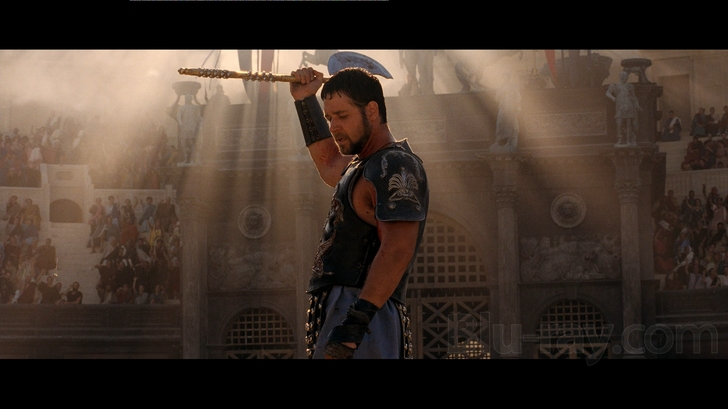
In this scene, Maximus is standing over the defeated Tigris of Gaul. Before this, Tigris had never been beaten, so it is a big deal. The crowd is going crazy and ready for Maximus to kill him. Even Commodus said for Maximus to finish it. Although, he does not kill him. He is then labeled as merciful. In this shot he is seen very merciful. The lighting being the main purpose. The light is framing him perfectly, and shining all around him in this shot. The background is dark and blurred by the light making Maximus the main focus. Maximus is in the dead center of the shot. The angle is not straight on, but a slight low angle shot; showing he has the power. All these techniques emphasize Maximus. We see more of his personality coming out, in choosing not to kill Tigris. This action makes Maximus more popular, but aggravates Commodus greatly.
Gladiator Scene Analysis

In this scene of Gladiator we see Commodus murdering his father Marcus Aurelius. We see that Commodus is standing higher than Marcus with a close up shot, this symbolizes his ascension to power. Commudus is wearing all black, and there is not a lot of light shining on him. This portrays how evil he is. The bust of Marcus Aurelius in the back symbolizes that one era has come to an end, and his legacy is left behind.
"Gladiator" Scene Analysis

In this scene, and many of the final ones in the movie Gladiator, the costumes play a very important role in the shots. The main antagonist of the film is presented in an all white ensemble, juxtaposing his actions from his appearance. White is a sign of good, as Commodus wishes to present himself in his battle against Maximus. Commodus's opponent has been dressed in all black, because he wishes to dismantle his reputation to the common people before killing him. The lighting upon Commodus's figure reveals his true identity as well, as his eyes are very dark and shadowed as he has shown worsening traits throughout the progression films; in fact, most of his figure is shadowed, despite his all white appearance. The parts of his body highlighted are where he is weakest and the hero, Maximus, will deliver the blows of death in these areas.
Gladiator scene analysis

This scene shows the status between Commodus and Maximus, who holds a higher status and is dressed in the royal dress yet he is lower than Maximus. The height difference isn't well shown in this specific screenshot, but in the film, Maximus looks down at Commodus. This scene is right before their fight against each other, where Maximus ends up killing Commodus. An interesting aspect of this is that Commodus is wearing white which is normally a color of purity and innocence. Since he is an evil character the fact that he wears white could symbolize the fact that it is a color you can't hide behind, this, therefore, exposes how weak Commodus truly is.
Gladiator
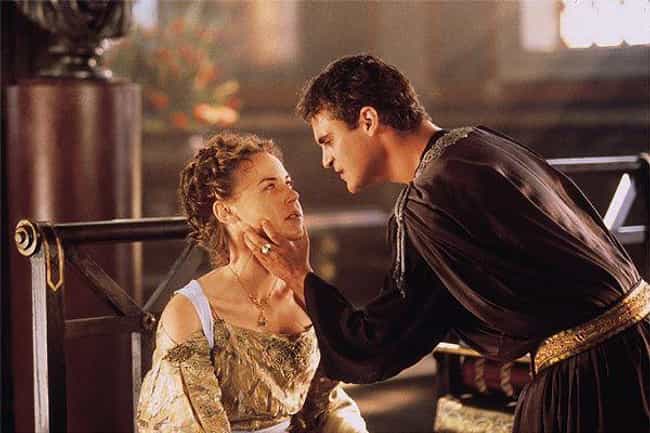
In this screenshot we see Commodus and his sister Lucilla. The lighting of this scene is the first thing that catches my eye. Lucilla, who is in a white dress and the light is hitting her face in a way that illuminates her inner beauty and light. She is a good person and this is only reflected in this lighting. Meanwhile, Commodus is in dark-black clothing and the lights hit his head from the back, casting a shadow over his face. This is exposing the inner darkness within him, which he really does not hide from others. Not only is his hand forcefully grabbing Lucilla's face, his power is also shown in the position of his entire body. Commodus is hunched over Lucilla, which shows that she is weaker and lower in status than he is. It also shows how powerless she is in their relationship, and the fear of having to subject to his sick intentions.
Thursday, October 10, 2019
A Funny Thing Analysis
A funny thing happened on the way to the forum scene analysis:
- Scene begins with a close up of the two slaves
- A close up of the sand timer is also seen
- This shows the importance of the timer to the scene
- They use a medium shot when they are shooting the acrobats
- When the acrobats are spinning it is close up on them but you can also see the slaves and the captain in the background
- The end of the scene is a close up with the captain and the slave
A Funny Thing Analysis SG
https://www.youtube.com/watch?v=dvIzAdqrb4U
-Camera angle shot from an upwards perspective to show how much taller Gloriosus was then Pseudolus. Also could be showing superiority of the Roman Captain.
-Multi-main character interactions with Pseudolus, Lycus, Gloriosus, and Hysterium.
-Close up of the two characters Pseudolus, and Gloriosus for majority of the scene.
-Quick cuts from Pseudolus cursing Lycus, and Lycus praising Pseudolus for taking his identity.
-Also cut to hero miserably failing at everything he attempted.
-Camera angle shot from an upwards perspective to show how much taller Gloriosus was then Pseudolus. Also could be showing superiority of the Roman Captain.
-Multi-main character interactions with Pseudolus, Lycus, Gloriosus, and Hysterium.
-Close up of the two characters Pseudolus, and Gloriosus for majority of the scene.
-Quick cuts from Pseudolus cursing Lycus, and Lycus praising Pseudolus for taking his identity.
-Also cut to hero miserably failing at everything he attempted.
A Funny Thing: Analysis
https://www.youtube.com/watch?v=Ahqu1nd3Zu8
- Uses many different camera angles...long shots, close-ups
- Colors stick out when compared to the background
- Choreo to show how “dumb” men are
- Full of misogyny...bleh
- Cool close up “thimble”
"A Funny Thing" Shot Analysis
https://youtu.be/ghfqnmL0d_A
Camera Angles and Technique:
- Close-ups to show the intensity in the scene
- Pseudolus and Hysterium at the start of the scene on eye to eye, neither are higher than the other. This shows us that they are equal in status
- Once the Acrobats come into frame, the shot becomes a long shot to show the action above and the people watching below.
- this particular scene interesting as the only people who seem entertained by the acrobats are Glorious and Pseudolus
- Mostly all of the shots are from a straight-on angle
- Pseudolus
- Bright colored
- More ragged looking
- Red-Orangish robes which the color represents aggression, and thirst for action. Which Pseudolus has throughout the whole movie
- Glorious
- Wears black which represents power, elegance, death, evil, and mystery
- Wears a soldier uniform that mimics Roman soldiers
- Marcus Lycus
- Wears different costumes throughout the movie but in this scene wears white which often represents safety. This is somewhat ironic in this scene as he is being thrown off balconies and out of windows.
"A Funny Thing" Scene Analysis
Intro Scene:
Camera Technique:
- Wide Variety of Shots
- Long shots, medium shots, close-ups
- Spectrum
- Long shots associated with people going about their business
- Close-ups show more embarrassing/comedic things
- Shaving, eating, horsing around
- All occur at random
- Helps establish the setting and tone
- Not meant to be taken seriously
- Overall cluttered field of vision throughout the whole scene
- "In a less fashionable suburb of Rome"
- Unlike our other films, the scope of the setting is much smaller.
- Panning shot only of the three houses
- In previous films, panning shots were usually used to show a vast landscape.
- This slow panning is used to show the intimacy of the setting
- Pseudolus is always either central to the camera or at eye-level to the camera.
- Pseudolus moves towards the camera, rather than the camera zooming into him
- Adds to the breaking of the fourth wall.
- Pseudolus is telling the audience his story.
Editing
- Cutaways during the first and third minutes.
- Edits seem to happen at random.
- All of the cuts show random snippets of everyday Roman life.
- Scenes that occur in the film are shown at random with no context.
- Editing syncs up with the music with fitting scenes near the end.
- Emphasizes how non-sensical the rest of the film will be.
- Pseudolus
- Brighter colored clothing
- Perhaps not as flashy as the soldiers, but it is more unique.
- It makes him distinguishable among those in the crowds.
- This helps let the audience know that he is the main character (before he even declares it).
Acting
- Most over-the-top acting than any of the previous films
- Exaggerated facial expressions from Zero Mostel
- Joyful to disgust to serious, back to joyful.
Wednesday, October 9, 2019
"A Funny Thing" Quick Scene Analysis
Camera Angle and Technique:
- Miles Gloriosus is shown at a ridiculous and exaggerated up angle
- Making sure the audience is aware that he is so much better than them
- He is looking down on us (also Pseudolus) as we look up, giving him all the power
- The shot is so ridiculous it's almost stupid, making the audience aware that he is stupid with all the power he has
- Pseudolus is completely powerless in Miles's eyes
- Pseudolus is shown at eye level with the audience
- We are on his side, we understand the story as he tells it
- From his perspective, he is not totally powerless compared to Miles
- Throughout the entire scene, Pseudolus is shown as shorter or smaller than Miles, not just in these shots, but even as Miles enters the house.
- Close-Up Shots
- Showing Miles very angry and later content with the news his bride is as pretty as him
- Showing Pseudolus very fearful of Miles
- Between Pseudolus and Hysterium as they are having an intimate conversation about what is actually happening plotwise almost to the audience; the story is not as Miles believes it is
- Medium Shot
- Showing Miles, Lycus, and Psedolus
- As they discuss who is the real Lycus between them, the real Lycus is standing in the middle of the shot as he is the topic of conversation
- Long Shot
- Showing Hero and a mare
- Hero is shown being weak, we watch as he falls and struggles to move a horse
- He is "the good guy", but we the audience know that we are more competent than he because we are watching him struggle
Costumes:
- Miles Gloriosus
- Wears black because obvious "bad guy"
- mimics Roman Solider attire
- Miles's Army
- wearing black and blue, obvious "bad guys"
- mimics Roman Solider attire
- Hero
- Wears white because obvious "good guy"
- Pseudolus and Hysterium
- Wear less flashy clothing compared to characters of higher status
- However, stand out from other slaves in the movie
- wearing all one bright color to distinguish
- Lycus
- Closely resembles Pseudolus and Hysterium
- wearing all purple, but with a hood to disguise himself
- Slaves/ background people
- wearing non-distinguishable clothes and colors like gray and brown.
"A Funny Thing" Shot Break Down- Gladiator Training
There are a mixture of long, medium, and close up shots.
Long shots are used to show off the setting of the training camp. This establishes the scene. There are long shots of the gladiator hitting the slaves in the head, making the line get smaller and smaller, and closer to Hero. This could create suspense in the audience.
There are medium shots with Pseudolus and the guard with a straight on angle. Focusing in on the conversation between the two, showing how dumb the guard is, and how easy it was for Pseudolus to get by; with a simple change in costume. There are medium shots of the gladiator and trainer playing into the mocking of gladiator training.
The close up are used to show the emotion in the character's faces. A close up of Hero shows his fear of getting clobbered in the head, like all the others before him. There are close ups Pseudolus when trying to get Hero's attention, which are very comical.
There is a comedic shot reverse shot of Pseudolus, Hero, and the gladiator and trainer. He is trying to save Hero, but nothing is working since Hero's eyes are shut. The gladiator is getting distracted by Pseudolus' weird faces and movement, and by then he should have already hit Hero.
It goes back to a long shot to show Hero was saved and the Gladiator accidentally hit his trainer.
This whole scene picks fun at gladiator training, while going along with the story line with Pseudolus, very comically, saving Hero.
"A Funny Thing" - Quick Scene Analysis
https://youtu.be/QPds0-hZ1tM
Soothsayer Scene:
Costume:
- Exaggeration of ancient dress
- Workers/Slaves are in drab clothes
- Aristocrats and other important figures are in color
- Erronius
- He is an aristocrat
- Pseudolus and Hysterium color because they’re main characters
- Also makes them stand out in a dramatic way
Sets:
- Outside in the streets
- Mocking the slums not shown in ancient movies
- Dirty aspect of rome
- Inside the buildings
- Nice, but obviously fake
- Shows the play/musical aspect of the movie
Camera Angle/Techniques:
- Long shots
- Most important:
- Beginning to see Erronius being carried in
- Dramatic differences between slaves & not
- Women stereotypes
- Close up
- Faces of Pseudolus, Hysterium, and Erronius
- Exaggerated emotions
- Ring
- Mock the significance and importance of rings in ancient movies
- Medium shot
- When Pseudolus and Hysterium are tricking Erronius
- Shows how the man can’t see everything that happening
- A form of dramatic irony in the movie-musical
Tuesday, October 8, 2019
Was Nero a Monster?
I believe that yes, Nero was quite monstrous. Although he is commonly portrayed as one of the great Roman emperors, it doesn't excuse his many heinous acts. Nero is just as often depicted as being incredibly power-hungry, greedy, and all other manners of horrible. It is common fact that Nero had his own mother killed, an act that is widely regarded as trying to take total control of the throne, as his mother often tried to use her son as a puppet for her own desires. In addition, he was chased out of Rome by angry mobs and his life ended in a miserable suicide. No man who was so widely hated by his own people, and willing to burn their city at that, could be truly misunderstood.
Was Nero a Monster?
I think based on the reading Nero was definitely a monster. The beginning of his movie might have been hard, but he still made his own decisions. I think that he definitely had good intentions at the beginning of his reign but that didn’t not continue to the end. He did a lot of bad things throughout his reign. He murdered two of his wives and might have conspired to kill his adopted brother. I think that he is monster and not misunderstood.
Nero Was A Monster
Nero, at no point, can he be considered, misunderstood. By all accounts, he was a monster. Exiling his mother, inviting her back four years later, only to have her killed shortly thereafter, just to hoard the power all for himself is beyond scummy. His outbursts out in public are straight-up psychopathic and what he did to his wives was horrifying. He's also kind of stupid as well, making enemies out of the senate the way that he did. It could be argued that his upbringing without a father is what made him turn out the way he was, but it still doesn't excuse the disgusting things he did. Neither do the charitable things that he did after the Great Fire. That was probably just to save his self-image. Bottom line, he was an absolute monster. For an actor's portrayal, I would choose either Robert Downey Jr. or Joaquin Phoenix (Spencer, I swear I'm not copying, I had the same idea). RDJ can play up the playboy side of his personality and he can come across as unsettling when he tries to be intimidating. Phoenix, not only in his role as Commodus in Gladiator but also with his most recent role, The Joker, has shown me that he can play a ruthless monster, lacking any kind of remorse, while also being serious when he needs to be. I would've chosen Micheal Keaton, who does a great job at showing composure and insanity in the same role, but he wouldn't look the part.
Monday, October 7, 2019
Nero was a bum
Nero was a guy that wanted to do whatever he wanted and abuse his power. He is a monster for starting the Great fire no doubt He wanted to make all of these decisions that affected people's lives but when people called him out for starting the fire he didn't want to take the heat. He blamed it on the Christians. He was spoiled and did not understand how to rule a nation. This proved true with the result of life. That is why Nero is not only a monster but also a bum.
Was Nero A Monster?
From the reading, I felt that Nero was truly an awful person, and I don't think he was misunderstood. Many people in Ancient Rome did terrible things, and Nero is just one of the names on the list, from murdering two wives, a step-brother, and his own mother to mugging Roman citizens on the street. One of the only good things that Nero contributed to Roman society was that during his first five years of reign the government flourished and was called the "Golden Age of Moderate and Responsible Government". This good reputation was quickly torn down when Nero ordered his soldiers to kill his mother who had already been exiled. In Nero's free time he would go out with his friends and attack women and abuse married women. An interesting fact about Nero's life is that he was gay, and had many male partners, this could explain maybe why he was so cruel, because he felt he couldn't be himself, therefore, he felt he needed to push his pain onto others. Even if so, this doesn't excuse his terrible behavior over the course of his life.
Was Nero a Monster or Misunderstood?
I think Nero has earned the right to go down in modern history as a cruel monster; based on the reading by Scarre, there isn't anything to be misunderstood. Despite any positive political intentions Nero had in the beginning of his reign, or even during the Great Fire of Rome, he was cruel in his personal endeavors. Nero murdered two of his wives, and Scarre's account of both make them seem like nonchalant decisions; one simply because he wanted to marry someone pretty, and the other because he had a temper tantrum. I think that alone is enough to disregard any inkling of doubt about Nero. On top of those two murders, he murdered his mother and his step brother. Simply being a "patron of the arts" is not enough to redeem murder and alleged mugging, attacking of women, and stealing.
Was Nero a Monster?
The modern actor I would cast as Emperor Nero would be either Jack Gleeson or Joaquin Phoenix. They both have done incredible jobs portraying evil characters in the past with Game of Thrones, and Gladiator. Jack Gleeson has Nero's blonde hair and he can play that character because he's played a similar role for multiple years. Joaquin Phoenix played Commodus in Gladiator, he does a great job playing an evil character and would do great portraying Nero. After reading the article, I would definitely say Nero was a monster. He murdered his own mother, and two of his wives. He also abused, stole, and sexually harassed many others. This takes it far past the levels of simply being misunderstood.
Best Modern Actor for the Role of Nero
Taking into account all that I've learned about Nero, I would say that Tom Hiddleston would be the best candidate for the role. Given that Nero was not a warrior, he probably had a slim stature, like the one that Hiddleston posesses. And when looking at the variety of roles that Hiddleston has played, having him be a mix of a playboy, a villian, and a likeable character would be well within the realm of what he can do.
What Modern Actor Could Play the Role of Nero
Based on the description of Nero, both his physical stature and his personality. I personally think Matthew McConaughey would be the perfect fit. Not only is he physically equivalent with a Greek God, he has the right physical height and stature. His acting abilities are also very superior and he would be able to pull of Nero's villain-like nature, and still be likeable at the same time.
Was Nero a Monster?
Nero did not start his reign as a monster, but the amount of power he received, mixed with his own reliance on that power and his greed, turned him into a monster. He had goals and promises that could have been great for Rome, but this was quickly covered up by his less-favorable actions, which included a significant amount of murder. Based on the reading, he was an egotistical ruler who repeatedly clashed with the senate. However, the reading also said he had a good relationship with the people, leading to the idea that there could be some misunderstanding in his overall contribution to the general public even with his obviously terrible relationship with the senate. Still, his memorable actions characterized him as a total monster.
Was Nero a monster? Absolutely
Although some may argue that Nero was misunderstood and he was actually a good person since he helped so much during the Great fire, He was still a monster.Yes he organized relief measures, opened temporary shelters, provided cheap grain and when the fire was finally out he gave founds for restoration. However, he still murder his mother and a step brother, he killed two of his wives. He kicked his wife Poppaea to death while she was pregnant, and attacked women. There were rumors that his friends and him mugged people at night, and he tortured and killed his enemies. So even if he did help a lot of people, he was still a monster. All those horrible things he did makes him monster regardless of what good he did or who he helped.
https://www.youtube.com/watch?v=ghfqnmL0d_A
https://www.youtube.com/watch?v=ghfqnmL0d_A
- Close up shot( shows their face expressions telling us that they are worried )
- Low angle (we see acrobats on the second floor entering with a low angle)
- Bored Soldiers in the fore ground, acrobats in the background
- Soldiers and maids in the background not entertained
- The back of the set looks fake (painted windows, pillars etc)
- Full shot of everyone
Nero
In Scarre's account of Nero I am not sure how he can be misunderstood. Labeling him as a monster and cruel seems accurate. He murdered various people harshly. He got his wife, Octavia killed because he had feelings for another women, Poppaea. Nero then married her, but while throwing a tantrum murdered her while she was pregnant for a second time after their four month child had died. Before all this also getting his mother killed. In addition, he harassed random people on the street at dark, stole from shops, and bribed judges at the Olympia. After the Great Fire he had tried to help, but even then his people believed he was the one that started the fire to make room for his golden house. With the information in this reading Nero does seem like monster, and there is not much room to misunderstand him.
Sunday, October 6, 2019
Was Nero a monster?
After reading all of the texts about Nero I think that he is truly a monster. No one that is that incredibly violent and cruel can be labeled as misunderstood. When I read the part about him kicking his pregnant wife to death I grimaced with shock and disbelief. I cannot image how aggressive and heartless someone would have to be to do this. The fact that he had his mother killed also demonstrated how much of a cruel man he was. Maybe he was a strong and stony leader but I think he was also a monster. Because Nero had absolutely no sympathy for anyone I think we can accurately label him as monster.
Thursday, October 3, 2019
Should we watch "A funny thing"
I think that racism, sexism, and rude remarks are because of the comedy genre of the movie. If you know you will be offended by that kind of raunchy comedy then this probably isn't the movie for you and I would avoid it. Not saying that that stuff, in general, is ok but I think it's important to know that this kind of stuff is said and things are a lot different nowadays compared to the 60's when the movie came out.
"A Funny Thing" - Should we watch it?
I wholeheartedly think everyone should watch this movie. While there is an astounding amount of inappropriate and offensive jokes, they are jokes, they aren't meant to be taken seriously. The jokes where made as a mockery on what Rome had once done and where very good at it. This should be something everyone watches just because it is a great comedy.
"A Funny Thing" - Should we watch it?
Despite the inappropriate jokes in A Funny Thing Happened on the Way to the Forum, I think it is still a movie musical that we should watch nowadays. This is because it is a comedy, so those watching it should be prepared for highly inappropriate jokes to begin with. One should never watch comedy with the expectation that something said won’t shock or offend them in even the slightest way. Also, I believe that the film is also a representation of the time it was produced, and changing things in it would change the original purpose and meaning of the movie. I believe that although A Funny Thing Happened on the Way to the Forum does make some off-color jokes, it is still simply a comedy made to entertain viewers, and it succeeds in doing just that.
“A Funny Thing”
Even though “A funny thing” has inappropriate content (such as racism, sexism, etc.) I still think that we should watch the movie. For one reason we can examine the inappropriate content within the movie. I also think that taking the movie with a grain of salt is important. I think that it is also important to note that the movie doesn’t just market fun of one group, the movie makes fun of all the groups in some way. The woman are portrayed as slutty and submissive but it’s over exaggerated. Then Roman’s are portray as self center, the men in general also portrayed as slutty, as well as other groups. All the groups in the movie are made fun in an ironic way. I think because of this and the fact that the delivery of the characters is in a comedic way that the movie still has value and that we should continue to watch the movie.
Should we watch "A Funny Thing" anymore?
I believe that yes, we should continue to watch and examine this movie, as well as other movies that may contain material that would be considered insensitive by today's standards. I believe this for three reasons. First, many of the movie's strongest points and funniest moments have nothing in the way of sexist material, such as the scene where Buster Keaton's character is told he must run around the hills 7 times. Secondly, many movies that contain offensive material have achievements that can not be understated, such as "Birth of a Nation," a movie glorifying the KKK being the first 3-hour film, and "The Jazz Singer," the first feature-length sound film, in which the main character spends a significant amount of screen time in blackface. Although it is not wrong to look down on these acts by modern standards, I think the technical achievements of these movies are far more important than the content they contained. Third, many movies are pieces of their time, and instead of immediately looking to condemn the content they contain, they are better examined as historical pieces for us to understand why that content was accepted and why it is seen as unacceptable today.
Racism!!! Sexism!!! and more !!!
This movie is indeed very controversial and offensive but I believe that we still should watch it. I think if we throw out everything that offends us from the past it is impossible to learn new things. If we still watch this type of media the public can also see the growth in society. Don't get me wrong, this film is extremely racist and sexist. The constant portrayal of women as objects and the racists scenes in the brothel was something that was a little uncomfortable to watch. But, the fact that especially in this film, everyone was made fun of made it almost more acceptable. It wasn't just the women being portrayed as ignorant sluts, it was also the men! We can see the Captain being so full of himself he can barley function. The slaves can barley work because they are so ignorant. Everyone is being made fun of so in an ironic way, it makes it less offensive simply because everyone is laughed it. The producers didn't just chose one group to make fun of, they decided to alienate and laugh at everyone. Even though this film is highly offensive, I think that we should still watch it.
youtube video link- https://www.youtube.com/watch?v=1EtA0HrUrYM
Analysis
-Captain is shown above the slave multiple times establishing that the Captain has more power.
-The guards are all dressed in black which demonstrates that they should be seen as evil. Black has a negative connotation with things that are evil
-Captain is also dressed in black, evil
-"bride" in white, innocence and purity, ironic because it is not actually the Captain's bride
-Close up shots, birds eye view, medium shots
-Direct eye contact with the camera creating a personal insight
-Lots of close ups on the Captain's face demonstrating his strength because he is literally the main focus of the shot
youtube video link- https://www.youtube.com/watch?v=1EtA0HrUrYM
Analysis
-Captain is shown above the slave multiple times establishing that the Captain has more power.
-The guards are all dressed in black which demonstrates that they should be seen as evil. Black has a negative connotation with things that are evil
-Captain is also dressed in black, evil
-"bride" in white, innocence and purity, ironic because it is not actually the Captain's bride
-Close up shots, birds eye view, medium shots
-Direct eye contact with the camera creating a personal insight
-Lots of close ups on the Captain's face demonstrating his strength because he is literally the main focus of the shot
Should We Even Watch "Funny Thing" Anymore?
On the grounds of it being offensive content, the film serves as a reminder that these stereotypes did exist at some point and that we've evolved past them. If anything, the film is meant to mock these tropes that were prevalent in older toga movies, such as the objectification of women. This movie is clever with how it handles its offensive jokes and doesn't just rely on shock value for laughs, like a lot of lesser comedies. I think it should still be watched to this day. In the case of a reboot, for it to be effective in its comedy, it would have to retain a lot of its risque humor, which may be controversial.
Wednesday, October 2, 2019
"A Funny Thing..."
Although, this film involves much sexism along with racism and inappropriate jokes, I do believe we can still watch it nowadays. It is picking fun at the way the Romans were and it is not harshly depicting racism and sexism throughout, as seen in other toga movies. There are several moments of just stupid, childish humor that an audience could laugh out, being someone falling or making a funny face. I was able to not take most things seriously in this movie and at times laugh.
"A Funny Thing" - Should We Watch?
Though A Funny Thing makes inappropriate, racist, and sexists jokes throughout the movie, it knows what it is. The traditional tropes of toga movies, which are also very racist, sexist, and inappropriate, are inherently ridiculous in the modern world. The point of the film is to present these tropes in a ridiculous and comical way, taking away the seriousness of other toga movies; it's equivalent to Hollywood making fun of itself. A Funny Thing should still continue to be watched because it is not making fun of the awful history of racism and sexism for the sake of making fun of it. It is worth the watch because we relate to questioning the ethics of the previous toga films, and this movie makes fun of those for us; comedy after all is another form of coping with and understanding something in an easier way. I do think, however, a modern remake would not work in today's climate, due to a culture of reacting based on initial impressions. Our current audience is a little more removed from the prevalence of these toga movies, and I think the jokes would come off as more insensitive when removed from the context it was made in.
"A Funny Thing"
The sexist, racist, and overall inappropriate content in "A Funny Thing..." comes across as less serious and is delivered in more of a mocking style, therefore I feel like it's okay for us to watch it in current times although some audiences may still be offended by its humor. Also because we can pick up on the fact that they are just making fun of classic stereotypes. In a modern remake, I don't think they would need or be able to change much, because of its outrageous and joking nature and removing some of the more risky jokes would take away from the overall effectiveness of the film.
I personally think that the sexiest, racist, and other inappropriate jokes were not that offensive to the point that we shouldn't watch the movie. I think that we should watch it nowadays in order to analyze it and see what comedies from the time it was made were like. If there was I remake I think the only change they should make is that the main characters should have a change of heart at the end. The jokes should remain the same so the audience can get a sense of what things were like back then, but at the end the main character realizes that it's wrong to make jokes like that and they shouldn't make them. Overall I think it was a good movie, I really enjoyed it.
A Funny Thing...
The use of racist, sexist and inappropriate jokes in this film does not necessarily mean that we should not watch it. In reality all of the movies we have watched so far have consisted of blatant racism and sexism in a serious form. This film as a comedy makes these jokes to play on the real racism and inappropriate nature of serious toga films. I think this film was done in a very tasteful way, and was really entertaining.
Tuesday, October 1, 2019
"Casina" vs. "The Braggart Soldier"
Both of these plays had rather questionable plot-lines regarding the women, and honestly would not bode well in a modern movie environment; entrapment of women and slaves, taking advantage of them, etc. However, I think the most suitable for a movie adaptation would be "Casina" because I think there is a good array of characters that is easy to keep track of, the story is easier to follow than that of "The Braggart Solider" and it was overall more comedic. The story of a vengeful wife getting back at her unfaithful husband is a little more relatable to a modern audience, though the part where Lysidamus is ashamed for being sexual with Chalinius would also be a little questionable. Getting revenge on Lysidamus for taking advantage of who he thinks is Casina I think is more satisfying to read than getting revenge on Pyrogopolynices; that's because the woman - Cleostrata - is getting the last laugh.
The Braggart Soldier vs. Casina: Which is more suitable for a movie adaptation?
I think that Casina would be a better suited play for a movie adaptation. The plot was very straightforward and there was a reasonable number of characters. I enjoyed Cleostrata's constant scheming to catch her husband, it was by far the funniest bit from either of the plays. The end of the play was also very satisfying and reminiscent of movie plots. The Braggart Soldier was generally less interesting. The plot was over-complicated and it was hard to keep up with all of the characters. I think that Casina was funnier and is therefore more suitable to be a movie.
Casina v. The Braggart Soldier
I preferred "Casina" over the "The Braggart Soldier" because I felt that the story in "Casina" was much easier to follow. While both stories had no such good themes of trapping women and exploiting them, I liked the plot of "Casina" better, and the witty banter kept the story moving and interesting. One thing that both plays had, but "Casina" did better, was the use of fourth-wall breaks. The breaks in "Casina" develop the characters and add funny details to the story, and the breaks in "The Braggart Soldier" are less developmental and the characters aren't thinking to themselves they are more just bragging to themselves. Overall I felt "Casina" was the better read and better-formatted play.
Casina vs The Braggart Soldier
While "The Braggart Soldier" would definitely make for a better movie, with its more "complicated" plot and characters, I enjoyed reading "Casina" more just for how absolutely bonkers it could get. I was shocked at times with how vulgar the play would get at times. Nowhere else will I find characters that hate each other for no reason as much as the characters in this play. It was also much easier to read, as well. One thing I noticed "Casina" did better was its fourth-wall breaks. In a lot of them, the characters are just contemplating and might as well be speaking to themselves. They help develop the characters. In "Braggart Soldier," many of the fourth-wall breaks are just the characters bragging about how great they or their plans are, which is probably the point, but it often breaks the pace of the play for me. Overall, "Casina" was the better read for me.
Subscribe to:
Posts (Atom)